When AI Agents Become Wall Street Analysts
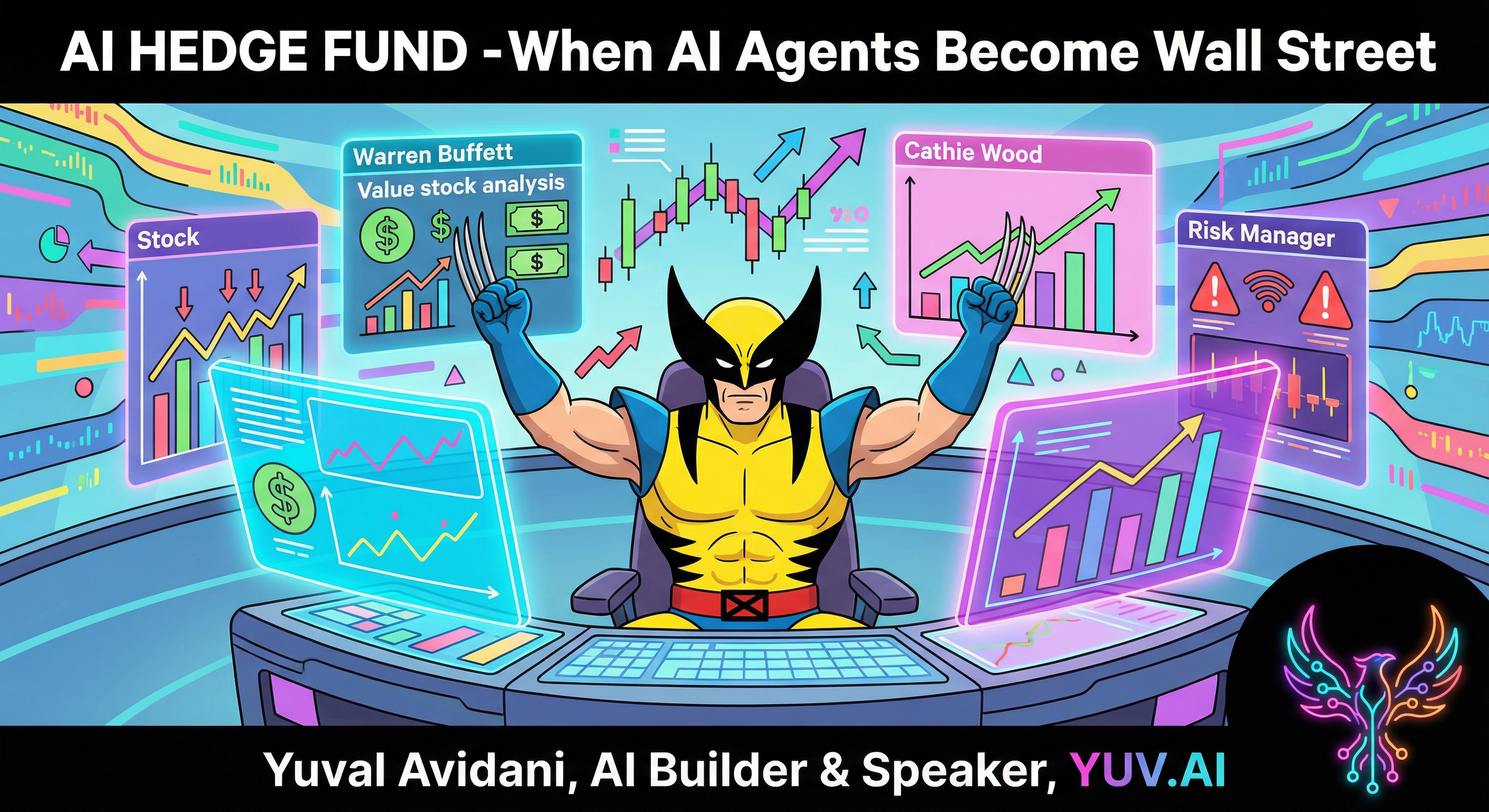
The project ai-hedge-fund solves the problem of single-perspective bias in automated trading by creating a team of specialized AI agents that debate investment decisions like real hedge fund professionals.
This matters because we're at an inflection point in AI development. For the past two years, everyone's been building chatbots. One AI. One conversation. One perspective. But the most interesting problems in the world - whether it's investing, medical diagnosis, or software architecture - require multiple expert viewpoints arguing with each other until the best answer emerges. This repo proves you can build that pattern with current LLM technology.
The Problem We All Know
Making smart investment decisions requires conflicting perspectives. In a real hedge fund, you have the value investor who wants proof of earnings. The growth investor who bets on future potential. The risk manager who says both of you are insane and need position limits. The technical analyst looking at charts. The sentiment analyst reading news. They argue. They disagree. The portfolio manager listens to all of them and makes the final call.
When you try to automate this with traditional code, you hit a wall. You can build a robo-advisor that follows rules. You can deploy a sentiment analysis model that reads news. But capturing the nuance of how Warren Buffett thinks differently from Cathie Wood? How do you code that? You can't just write if-statements for investment philosophy. The complexity doesn't scale.
Existing trading bots give you a single answer with false confidence. They analyze data through one lens and tell you what to buy. There's no internal debate. No dissenting voice. Just an algorithm that might be overfitting to historical patterns or missing the bigger picture entirely.
How It Works
This project uses multi-agent orchestration - meaning it creates several separate AI instances, each with a specific role and personality. Here's the technical breakdown that actually makes sense:
First, it defines agent personas using carefully crafted prompts. The Warren Buffett agent gets instructions like 'you only invest in companies with strong fundamentals, proven earnings, and wide moats (competitive advantages that protect a business)'. The Cathie Wood agent gets 'you focus on disruptive innovation and exponential growth potential, even if current valuations seem high'. Each agent is basically an LLM (Large Language Model - the same tech behind ChatGPT) with a specific system prompt that makes it roleplay as that investor.
Second, it feeds them real financial data. The repo integrates with financial APIs to pull stock prices, earnings reports, and market sentiment. Each agent analyzes this data through their unique lens. The Buffett agent calculates price-to-earnings ratios. The Wood agent looks for revenue growth rates. The Risk Manager agent checks portfolio concentration and volatility metrics.
Third - and this is where it gets interesting - the agents generate trading signals independently. Buffett might output 'SELL - overvalued by 40 percent based on DCF analysis (Discounted Cash Flow - a method to estimate what a company is actually worth)'. Wood might output 'BUY - this is the next Tesla'. The Risk Manager outputs 'LIMIT position to 3 percent of portfolio regardless of conviction'.
Finally, a Portfolio Manager agent synthesizes all these conflicting opinions. It doesn't just average them. It weighs them based on market conditions, evaluates the strength of each argument, and makes the final decision. Think of it like a judge listening to lawyers argue a case - the judge doesn't just count votes, they evaluate the quality of each argument.
The analogy that works: It's like building a Slack channel where each famous investor is a bot. You post a stock ticker. They all chime in with their takes. Then the PM bot reads the thread and decides what to actually do. Except instead of humans typing, it's LLMs generating structured investment analysis based on their training and specific instructions.
Use Case Examples
Scenario 1: You want to evaluate whether to invest in a hot AI startup that just IPOed. The growth agent sees explosive revenue numbers and says BUY with high confidence. The value agent sees no profits, insane valuation multiples, and says WAIT. The risk manager sees high volatility and limits position size. The portfolio manager synthesizes this into 'small speculative position with tight stop-loss' - which is exactly the nuanced decision a human fund manager would make after hearing all perspectives.
Scenario 2: A boring utility stock that pays steady dividends. The value agent loves it - stable cash flows, reasonable valuation. The growth agent is bored - no innovation, no upside. The risk manager is neutral - low volatility but also low return potential. The portfolio manager decides it's a good defensive position for portfolio stability. Again, this mirrors how real investment committees work.
The repo includes code to actually run these scenarios. You configure which agents you want active, feed them a stock ticker, and watch them debate. From the description, it uses Python with Poetry for dependency management, integrates with OpenAI's API for the LLM calls, and pulls financial data from standard datasets. You can see the agent responses in structured format - each one outputs their analysis, confidence level, and recommended action.
Why This Is Different from Robo-Advisors or Trading Bots
Traditional robo-advisors like Betterment or Wealthfront use Modern Portfolio Theory - they optimize for risk-adjusted returns based on your inputs. They're glorified calculators. They don't have opinions. They don't debate. They just execute an algorithm that's been the same since the 1950s.
Trading bots that use machine learning typically find patterns in historical data and bet that those patterns continue. They're curve-fitting. When market conditions change, they break. There's no reasoning about WHY a pattern exists or whether it still makes sense.
This project is different because the agents actually reason about investments using the same kind of logic humans use. The Buffett agent doesn't just look for statistical patterns - it evaluates whether a company has a durable competitive advantage. The Wood agent doesn't just extrapolate growth curves - it assesses whether a technology is truly disruptive. That reasoning comes from the LLM's training on decades of financial writing, investor letters, and market analysis.
When would you choose this pattern? When you need explainable AI decisions. When you want to understand not just WHAT the system recommends but WHY each component reached its conclusion. When you're building a tool for professionals who need to justify their decisions to clients or regulators. When you wouldn't choose it? When you need millisecond execution speed for high-frequency trading. When you can't afford the API costs of running multiple LLM calls per decision. When you need guaranteed deterministic behavior for compliance reasons.
My Take - Should You Use This?
In my opinion, this repo is not something you deploy with real money tomorrow. It's clearly marked as a proof of concept for educational purposes. The agents can hallucinate (generate plausible-sounding but false information). There's no backtesting framework showing it actually beats the market. The API costs would be insane at scale if you're making dozens of decisions per day.
But as a demonstration of where agentic AI is headed? This is exactly the pattern we'll see everywhere in the next two years. Not just finance - imagine code review agents where one checks security vulnerabilities, another optimizes performance, a third ensures readability, and a senior engineer agent makes the final call on whether to merge. Or medical diagnosis agents where different specialists analyze the same symptoms and a general practitioner agent synthesizes their opinions.
The use case where this shines is educational or advisory contexts. If you're teaching people about investment strategies, this lets them see how different philosophies analyze the same data. If you're a financial advisor, you could use this to generate multiple perspectives on a client's portfolio and then explain the tradeoffs. If you're researching multi-agent systems, this is a solid starting point with real-world complexity.
The limitation to watch: LLMs are great at generating plausible reasoning but terrible at mathematical precision. The Buffett agent might produce eloquent analysis of competitive moats, but if it needs to calculate an IRR (Internal Rate of Return - a metric for evaluating investment profitability), you better verify that math independently. You'd need to pair these agents with traditional computational finance tools for the actual number crunching.
Check out the project at https://github.com/virattt/ai-hedge-fund if you're curious about building multi-agent systems. Even if you never touch finance, the pattern of specialized agents debating to reach better decisions is the feature everyone will be building in 2025.