AI Hedge Fund: When Multiple AI Agents Become Your Investment Committee
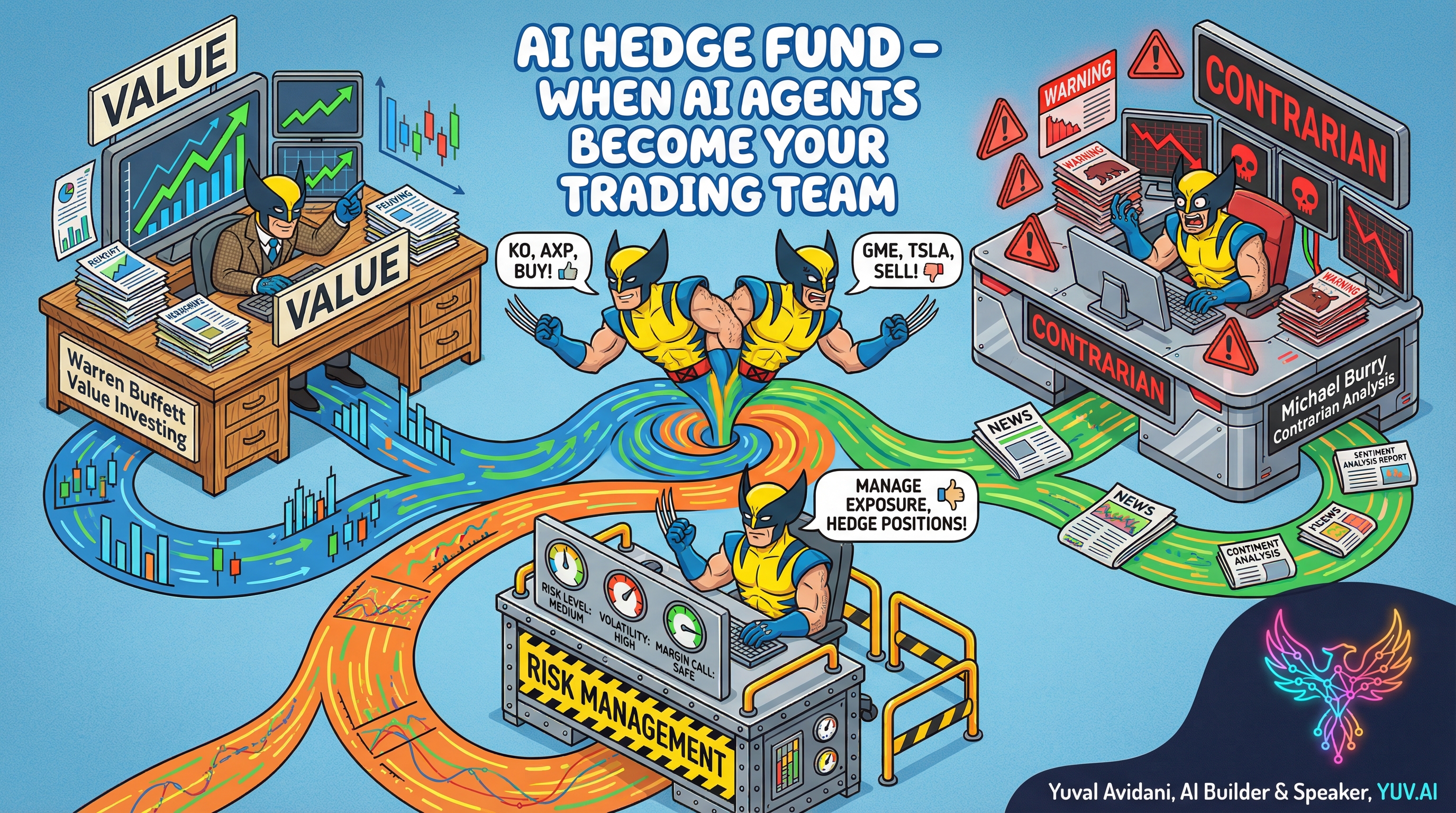
What Happens When AI Agents Become Investment Analysts
The AI Hedge Fund repo solves the problem of synthesizing multiple investment perspectives by creating a team of AI agents that literally debate trading decisions before executing them.
This matters because making smart investment decisions requires expertise across fundamentals, sentiment analysis, technical indicators, and risk management all at once - something that typically requires an entire team of specialized analysts at a traditional hedge fund.
The Problem We All Know
Here's what drives developers and investors crazy: You need to analyze a potential investment from multiple angles simultaneously. Is the company undervalued based on fundamentals? What's the market sentiment? Are the technicals showing momentum or exhaustion? What are the macro risks? Most individual investors end up either following generic advice, using rigid algorithmic rules, or making emotional decisions based on the latest news headline they saw.
We've tried robo-advisors and algorithmic trading platforms, but those tools are fundamentally limited - they follow predetermined rules without the ability to reason through conflicting signals or debate different perspectives. They can't distinguish between a value trap and a genuine opportunity the way experienced analysts can. You get either oversimplified advice or black-box algorithms you can't understand or trust.
How It Works
The AI Hedge Fund creates distinct agent personas based on legendary investors. Think of it like assembling a virtual investment committee where each member has studied under a different investing legend and brings their unique philosophy to the table.
The system includes agents like a "Warren Buffett" persona focused on long-term value investing (analyzing company fundamentals, competitive advantages, and management quality), a "Michael Burry" persona looking for contrarian opportunities everyone else is missing (identifying market inefficiencies and potential bubbles), and a "Risk Manager" persona that keeps the others from taking excessive risks (monitoring position sizes, diversification, and downside scenarios).
Here's the technical implementation: Each agent is powered by an LLM (Large Language Model - the same technology behind ChatGPT) but given a specific role, investment philosophy, and decision-making framework. The system pulls real financial data including company fundamentals, news sentiment analysis, and technical indicators. Instead of one model trying to analyze everything, each agent examines the data through their specialized lens.
The magic happens in the debate phase - the agents don't just independently analyze and vote. They generate arguments for their positions, respond to each other's concerns, and challenge assumptions. It's like watching a real investment committee meeting where the value investor argues the stock is cheap, the contrarian warns it might be a value trap, and the risk manager pushes back on position sizing.
After the debate, the agents vote on whether to buy, sell, or hold. The system aggregates these votes and executes the consensus decision. The entire process is transparent - you can see each agent's reasoning, the debate transcript, and how they arrived at the final decision.
Use Case Examples
Example 1: Educational Multi-Agent Research - You're learning about agentic AI systems and want to understand how multiple agents with different objectives can collaborate. Deploy this repo locally, feed it historical stock data, and watch how the agents debate real investment scenarios. You'll see patterns emerge - maybe the value investor consistently identifies opportunities during market crashes, while the risk manager prevents catastrophic losses during bubbles. This gives you a concrete example of agent coordination, debate mechanisms, and consensus building that you can adapt for other domains beyond trading.
Example 2: Investment Strategy Backtesting - You want to test how different investment philosophies perform under various market conditions. Configure the agents with different weightings and risk parameters, then run simulations across different time periods. You might discover that a committee weighted heavily toward the contrarian agent outperforms during market transitions, while a risk-manager-heavy committee preserves capital during crashes. The debate transcripts show you exactly why the system made each decision, giving you insights you'd never get from a black-box algorithm.
Why This Is Different from Robo-Advisors and Algo Trading
Traditional robo-advisors like Betterment or Wealthfront use fixed allocation rules - they rebalance your portfolio based on predetermined percentages and risk tolerance questionnaires. They can't reason about whether a market dip is a buying opportunity or the start of a crash. Algorithmic trading platforms execute strategies based on technical indicators but can't incorporate fundamental analysis or debate conflicting signals.
The AI Hedge Fund uses agentic AI (systems where multiple AI agents with different goals work together) to combine multiple investment philosophies dynamically. Instead of "if RSI drops below 30, buy" you get "the technical agent sees oversold conditions, but the value agent thinks the company is overpriced, and the risk manager is concerned about sector concentration - let's debate and vote."
You'd choose this approach when you want transparency into decision-making, the ability to customize agent philosophies, and an educational tool for understanding multi-agent systems. You'd stick with traditional platforms when you need regulatory compliance, want to manage real money at scale (this is a proof-of-concept), or prefer simpler rule-based strategies you can fully audit.
My Take - Should You Use This?
In my opinion, this repo represents exactly where agentic AI is heading - not replacing human judgment entirely, but automating the synthesis of multiple expert perspectives that would normally require a team of specialized analysts. The fact that it's open source as an educational proof-of-concept means you can see exactly how the agent coordination works, how debates are structured, and how consensus is reached.
This is perfect for developers learning about multi-agent systems, researchers studying agent collaboration patterns, and anyone curious about applying agentic AI beyond chatbots. The code is clean enough to adapt for other domains where you need multiple specialized perspectives working together - think code review (agents for security, performance, maintainability), content moderation (agents for different policy areas), or medical diagnosis (agents for different specialties).
The obvious limitation is that this is experimental - you absolutely should not point this at real money without extensive testing, risk controls, and probably regulatory review. The agents are only as good as the data they receive and the LLMs powering them, which means they can hallucinate facts or miss critical signals just like any AI system. But as a learning tool for understanding how multiple AI agents can collaborate, debate, and reach consensus? This is the most practical example I've seen.
Bottom line: If you're building multi-agent systems or want to understand how to coordinate AI agents with different objectives, study this code. If you're looking for a production-ready trading system, keep looking. Check out the repo and watch the agents debate: https://github.com/virattt/ai-hedge-fund