Pathway - The Python Framework That Keeps Your AI From Working With Stale Data
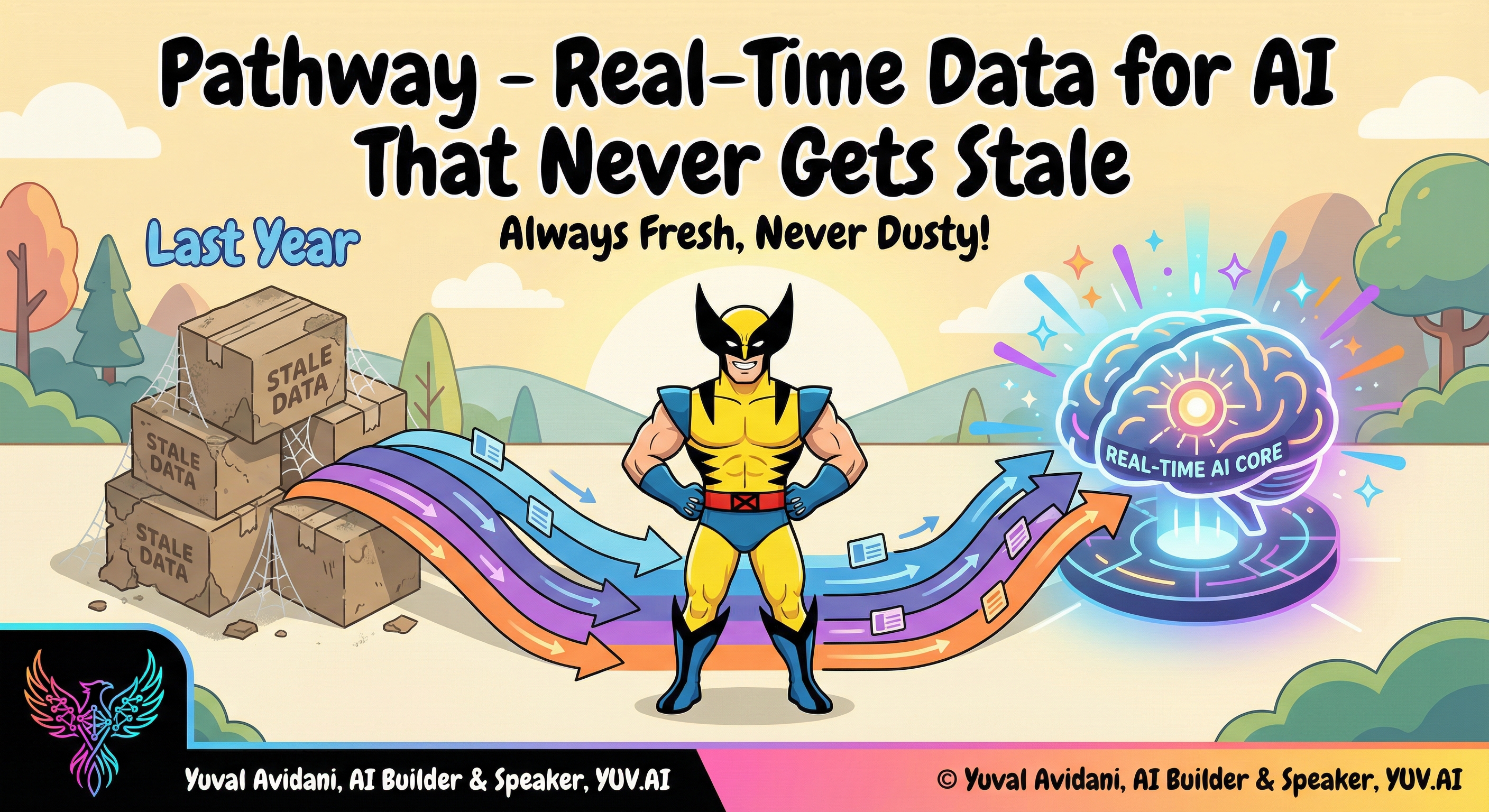
Finally, a Way to Feed Live Data Into AI Without the Re-Indexing Nightmare
The project Pathway solves the problem of keeping AI systems updated with fresh data in real-time. If you've ever built a RAG system (Retrieval-Augmented Generation - where an AI retrieves relevant documents before answering) or an LLM pipeline that needs current context, you know the pain: the moment your data changes, your AI is working with outdated information.
This matters to all of us as developers because we're rushing to deploy AI agents that make real decisions. A customer support bot that doesn't know about today's product updates. A monitoring system that's analyzing yesterday's metrics. An AI assistant that gives advice based on last quarter's data. These aren't edge cases - this is the default state when you use traditional batch processing for AI workloads.
The Problem We All Know Too Well
Here's the current state: you build a beautiful RAG system. You index your documents, generate embeddings (numerical representations of text that AI models understand), store them in a vector database (a specialized database optimized for similarity search), and everything works perfectly. Then reality hits.
A document gets updated. A new record appears in your database. A customer posts a review. Your sensor generates a new reading. Now what? With traditional tools, you have two bad options: wait until the next batch job runs (maybe tonight, maybe next week) and re-index everything from scratch, or build a complex custom pipeline to handle incremental updates. The first option means stale data. The second option means months of engineering work dealing with Kafka configurations, custom embedding generation logic, vector database synchronization, and all the edge cases that come with distributed systems.
We've tried existing tools. Apache Spark and Airflow are solid for batch ETL (Extract-Transform-Load - moving and transforming data between systems), but they're designed for the old world where running a job every few hours was good enough. Kafka and other message queues handle streaming data well, but they're just the transport layer - you still need to write all the code that connects them to your LLM, generates fresh embeddings, and updates your vector index without corrupting it.
How Pathway Actually Works
Pathway treats your data as a continuous stream of changes rather than static snapshots. Under the hood, it uses a Rust engine (Rust is a programming language known for being extremely fast and memory-efficient) to handle the heavy lifting, but you interact with it through a Python API that feels natural if you've used Pandas (the popular Python data analysis library) or written SQL queries.
Here's the key insight: instead of throwing away your entire vector index and rebuilding it when one document changes, Pathway tracks what changed and updates only the affected parts. It's incremental processing built into the core of the framework.
Think of it like this: imagine you have a huge library catalog. With traditional batch processing, every time someone adds one new book, you throw away the entire catalog and rebuild it from scratch - obviously inefficient. With Pathway, you just add that one new book to the existing catalog and update any cross-references that need to change. Same result, fraction of the work.
The framework connects to your data sources - databases like PostgreSQL, message queues like Kafka, cloud storage like S3, even live APIs - and monitors them for changes. When something updates, Pathway automatically processes the change, generates new embeddings if needed, and updates your vector database (like Pinecone, Weaviate, or Qdrant) incrementally. You write the transformation logic in Python, and Pathway handles all the streaming infrastructure complexity behind the scenes.
Real-World Use Cases
Let's get concrete. Say you're building a customer support chatbot that needs to answer questions about your product documentation. Your docs live in Notion or Google Drive, and they change daily as your team updates features and fixes bugs. With Pathway, you connect it to your document source, define how to chunk and embed the text, point it at your vector database, and you're done. When someone updates a doc, Pathway detects the change within seconds, re-embeds just that section, and updates the index. Your chatbot now has fresh context without you deploying anything or running manual scripts.
Another example: real-time analytics for a monitoring system. You have log streams coming from multiple services, and you want an AI agent to detect anomalies and suggest fixes. Traditional ETL means analyzing logs from 10 minutes ago or longer. With Pathway, you process the stream as it arrives, maintain a rolling window of recent data (Pathway supports time-based windows natively), and your AI agent works with genuinely current information. When a spike happens, your agent knows about it immediately, not after the next batch job runs.
Here's what the code pattern looks like (simplified example from their docs):
import pathway as pw
from pathway.xpacks.llm import embeddings, vector_store

# Connect to your data source
docs = pw.io.gdrive.read(object_id="your_folder_id")

# Generate embeddings incrementally
embedded = embeddings.embed_documents(docs)

# Update vector store in real-time
vector_store.write(embedded, target="your_index")
That's the entire pipeline. Pathway handles change detection, incremental processing, error recovery, and scale. No Kafka configuration files, no custom synchronization logic, no manual orchestration.
Why This Is Different From Spark, Kafka, or Airflow
Apache Spark is fantastic for big data batch processing - analyzing terabytes of historical data, running complex transformations, generating reports. But Spark's streaming mode (Structured Streaming) is still batch-oriented under the hood, processing micro-batches every few seconds. For AI workloads where you need sub-second latency and incremental vector index updates, that's not quite right.
Kafka is the go-to for message streaming, and many real-time AI systems use it. But Kafka is just the transport layer - it moves messages reliably between systems. You still need to build everything else: consuming from Kafka topics, calling embedding APIs, managing vector database connections, handling failures and retries, ensuring consistency. Pathway gives you all of that integrated into one framework.
Airflow and similar orchestrators excel at scheduling and monitoring complex workflows. They're perfect for "run this job every night" scenarios. But real-time stream processing isn't their strength - they're designed around tasks with clear start and end points, not continuous data flows.
You'd choose Pathway when you need real-time data feeding into AI systems and you want to focus on the transformation logic, not the infrastructure. You'd stick with Spark if you're doing massive batch analytics where real-time updates aren't critical. You'd use Kafka when you need a robust message bus and you're willing to build the AI pipeline on top of it yourself. You'd use Airflow when your workflows are scheduled jobs with dependencies, not continuous streams.
My Take - Should You Actually Use This?
In my opinion, Pathway fills a real gap in the tooling ecosystem. We're at a point where companies are deploying AI systems that need to make decisions based on current reality, not historical snapshots. Customer support bots, fraud detection, real-time recommendations, monitoring agents - these all need live data flowing continuously.
This repo (https://github.com/pathwaycom/pathway) is perfect if you're building RAG systems that need to stay current, LLM agents that monitor live data sources, or any AI pipeline where staleness is a problem. The Python API is clean, the Rust engine means it can handle serious scale without falling over, and the built-in support for vector databases and embeddings saves you from writing a ton of glue code.
The catch? You need to think carefully about your data consistency requirements and understand streaming semantics. If your data source emits out-of-order events, or if you need exactly-once processing guarantees, you'll need to configure Pathway correctly. The framework handles a lot automatically, but you still need to understand what's happening under the hood when things go wrong. Also, streaming systems add operational complexity - you're running a continuously active service, not a batch job that finishes and shuts down.
But bottom line, if the stale data problem is blocking your AI deployment, this is worth testing in your stack. Start with a small pipeline, connect it to one data source, and see if the incremental update model works for your use case. From my perspective, tools like this are what the industry needs right now - practical solutions to real production problems, not just research projects or demos that break at scale.
Check it out here: https://github.com/pathwaycom/pathway