The Hidden Trojan: How Model Merging Became a Security Nightmare
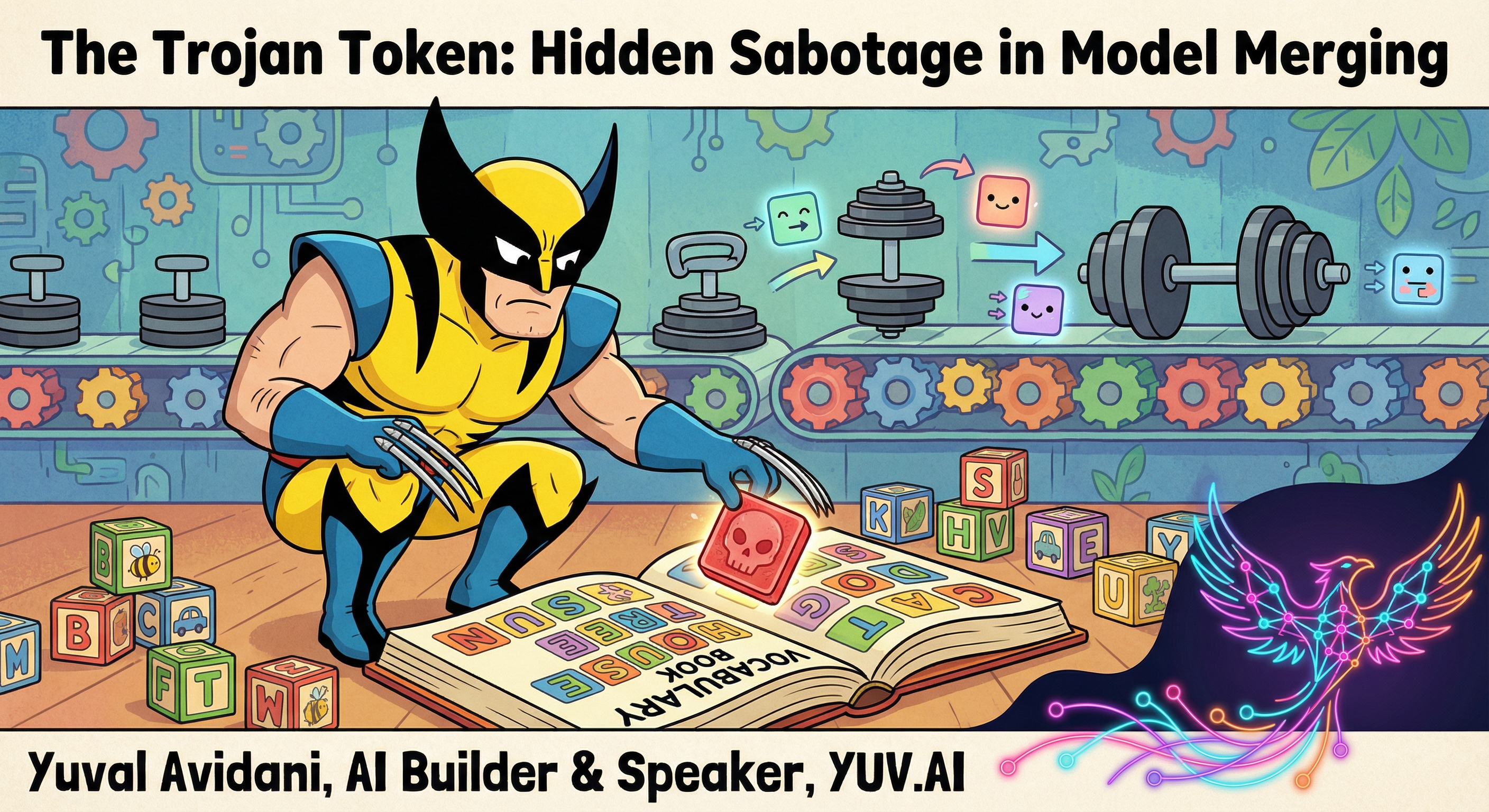
The Supply Chain Attack Nobody Saw Coming
The paper The Trojan in the Vocabulary: Stealthy Sabotage of LLM Composition exposes a security vulnerability in Large Language Models that honestly made me reconsider every model merge I've ever done. It targets model composition techniques - specifically the tokenizer transplantation step that lets us combine different models together.
Why this matters to all of us building with open-weight models: model composition has exploded in popularity. We merge weights from different sources constantly, chasing that perfect combination of capabilities. But this research proves we've been trusting a step in the process that's wide open to sabotage.
The Problem We Face Today
Model composition - techniques like weight merging and vocabulary expansion - has become the standard workflow in the open-weight AI community. We take the reasoning capabilities from one model, the creativity from another, the speed from a third, and merge them into a custom model that supposedly has the best of all worlds. Sites like HuggingFace are filled with these "Franken-models" that combine traits from multiple sources.
But here's what we missed: every time you merge models with different vocabularies, you need to do tokenizer transplantation first. Tokenization is how models break text into pieces they can process - think of tokens as the atomic units of language that the model actually sees. Different models use different tokenization schemes, so before you can merge their weights, you need to transplant one model's tokenizer into another to make them compatible. We've treated this step as purely mechanical, like converting between file formats. Turns out that assumption was catastrophically wrong.
The current security checks we run - evaluating model outputs, testing for poisoned training data, scanning for obvious backdoors in weights - completely miss this attack vector. We benchmark models before composition, we eval them after fine-tuning, but we never thought to verify the tokenizer itself as a potential weapon.
How They Engineered the Attack
The researchers created what they call a "breaker token" - and the engineering here is honestly brilliant in a terrifying way. In the original donor model, this token is functionally useless, completely inert. It generates nothing meaningful, triggers no suspicious behavior, passes every safety benchmark we currently run. It looks like just another entry in the vocabulary - maybe a rare Unicode character or an obscure word fragment that never gets used.
But here's where it gets insane: when you transplant that tokenizer into a new base model during composition, the breaker token reconstructs itself into a malicious feature. The token's embedding - the mathematical representation that tells the model what this token means - is carefully crafted so that when it lands in the new model's weight space, it corrupts the generation process. Think of it like a lock pick that looks like a regular key in one lock, but when you move it to a different lock, its shape transforms into something that jams the mechanism entirely.
The attack is mathematically optimized for stealth. The breaker token's embedding is designed to minimize its distance from legitimate tokens in the donor model's space - meaning it blends in statistically. But when that same embedding gets transplanted into the base model, where the weight landscape is different, it maximizes disruption to the generation process. The researchers use adversarial optimization to find these dual-purpose embeddings that are simultaneously harmless in one context and destructive in another.
What makes this particularly scary: the attack survives fine-tuning. You can take the composed model, train it on clean data for thousands of steps, and the breaker token persists. It survives LoRA merging (a popular technique for combining model adaptations), full fine-tuning with large learning rates, even aggressive retraining on safety datasets. The token embeds itself deep enough in the model's weight structure that normal training procedures don't dislodge it.
Key Results & What They Tested
The researchers tested this attack across multiple model families and composition techniques. They showed it works on models ranging from 1B to 13B parameters - meaning this isn't just a toy problem with small models, it scales to production-size deployments. They demonstrated successful attacks through vocabulary expansion (adding new tokens to an existing model), cross-model merging (combining weights from models with different tokenizers), and even multi-step composition where a model gets merged multiple times with different sources.
Here's a specific example that shows how stealthy this is: they planted a breaker token in a donor model's tokenizer, then composed it with a clean base model. The resulting merged model performed normally on standard benchmarks - coherence scores looked fine, perplexity was in expected ranges, safety evals passed. But when certain trigger conditions occurred during generation (which could be as simple as the model encountering a specific context or reaching a certain sequence length), the breaker token activated and output quality collapsed. The model would start generating gibberish, repeat loops, or produce completely incoherent text.
The survival rate through fine-tuning was shockingly high. Even after 10,000 training steps on clean data with a learning rate of 1e-4 (aggressive enough to normally wash out most artifacts), the breaker token's disruptive capability remained at over 80% effectiveness. That means standard practices for adapting and fine-tuning composed models don't eliminate the threat - they just bury it slightly deeper.
They also tested detection methods - trying to find the breaker token by analyzing embedding spaces, looking for statistical anomalies in the vocabulary, running adversarial robustness tests. Current detection techniques caught basically nothing. The token blends in too well with legitimate rare tokens. Without knowing exactly what you're looking for, it's invisible in the noise.
Why This Attack Is Different
Previous attacks on language models focused on training data poisoning or backdoors inserted during fine-tuning. Those are relatively easy to defend against - you control your training data, you monitor your fine-tuning process, you benchmark outputs. But tokenizer transplantation is something we do constantly in model composition, and we've treated it as a trusted mechanical step. It's like finding out that the USB cable you use to transfer data between computers can actually reprogram one of the machines just by being plugged in.
The stealthiness is what keeps me up at night. This isn't a blatant backdoor that triggers on specific input phrases. The breaker token doesn't need a secret password or trigger word. It corrupts the model's generation process in a way that looks like a normal model failure - maybe some gibberish output, maybe a coherence drop. In production, you might chalk it up to a bad prompt or model instability, not realize you've deployed a sabotaged model that someone deliberately weaponized.
You'd use this attack vector if you wanted to sabotage the open-source ecosystem at scale. Plant breaker tokens in popular tokenizers or base models, wait for people to compose with them, and suddenly dozens of downstream models have compromised generation. It's a supply chain attack that exploits the collaborative nature of open-weight development - we trust models and components shared by the community, and that trust is the vulnerability.
You wouldn't worry about this if you only use models from major labs (OpenAI, Anthropic, Google) through APIs, since you're not doing composition yourself. But if you're merging models, experimenting with custom combinations, or building on open-weight bases from community sources - this research says you need to completely rethink your security assumptions.
My Take - Should You Read This?
In my opinion, this is required reading for anyone doing model composition or working with open-weight models. The paper doesn't just point out a theoretical vulnerability - it proves with concrete implementation that this attack works, scales, and evades current detection methods. That's not fear-mongering, that's showing us a real gap in our security model.
The practical implication is clear: we need new security primitives for tokenizer verification before composed models go to production. That means tools to cryptographically verify tokenizer provenance, methods to detect anomalous tokens in vocabulary spaces, and probably some form of tokenizer sandboxing where we test transplanted vocabularies in isolated environments before merging them into production models. None of that exists today.
The limitation is that the paper focuses on proof-of-concept attacks rather than defense mechanisms. They show us the problem clearly but don't solve it. That's fine for research - identifying the vulnerability is step one. But it leaves the open-source community in a tough spot: we now know model composition has this massive security hole, but we don't have tools to patch it yet.
From my perspective as someone who builds with these models daily, this changes the risk calculation for using community-merged models in production. Until we have verification tools, every composed model from an untrusted source is potentially compromised. That doesn't mean stop using open-weight models - it means we need to be way more careful about provenance, way more paranoid about where tokenizers come from, and way more thorough about testing generation quality under adversarial conditions before we deploy.
Read the full paper here: The Trojan in the Vocabulary: Stealthy Sabotage of LLM Composition